When many people hear the name Dolly Parton, they immediately think of country music, unforgettable songs, rhinestones, and her unmistakable personality.
But Dolly Parton’s legacy reaches far beyond entertainment.
Her life’s work offers an important lesson for healthcare professionals: improving health does not always begin inside a hospital. Sometimes it begins with a book, a conversation, a donation, a community partnership, or simply recognizing what a family needs before a crisis occurs.
Following Dolly Parton’s death on August 25, 2026, at age 80, it is worth reflecting on the healthcare and nursing implications of the work she leaves behind. (Vanderbilt Health News)
Dolly Parton and the Bigger Picture of Health
Healthcare is much more than diagnosing disease and administering medications.
A person’s health is influenced by education, income, housing, transportation, access to healthcare, family support, literacy, and the environment in which they grow.
This is one reason Dolly Parton’s philanthropic work is so relevant to nursing.
Her initiatives have addressed several factors that influence health and well-being, including:
- Early childhood development
- Literacy and education
- Maternal and children’s health
- Access to healthcare resources
- Disaster recovery
- Medical research
- Community support
- Health equity
For nurses, this is a familiar concept.
We often see firsthand that a patient’s health outcome is influenced by circumstances outside the examination room.
The Imagination Library: Literacy as a Public Health Investment
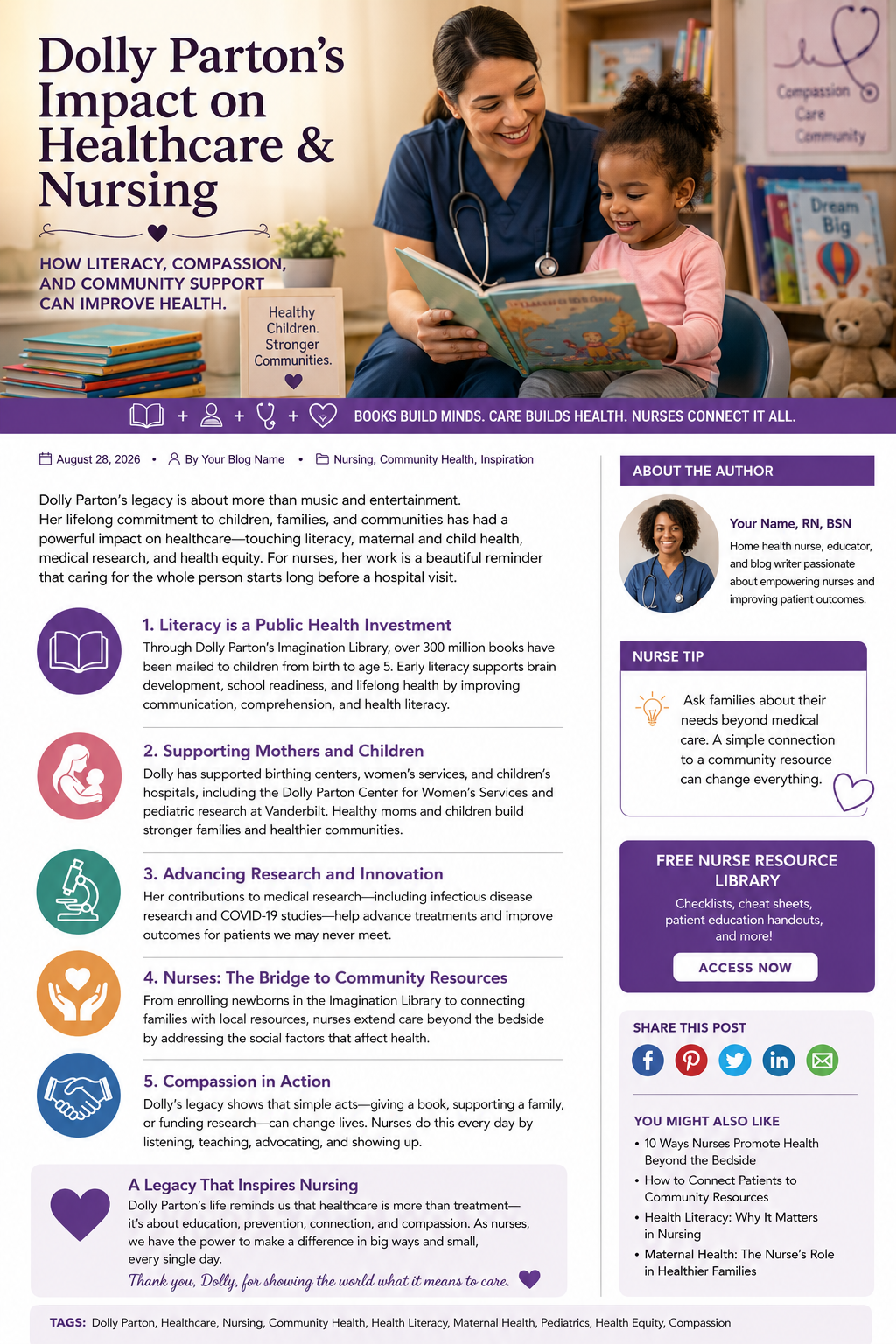
One of Dolly Parton’s most recognizable philanthropic programs is Dolly Parton’s Imagination Library.
She established the program in 1995, inspired in part by her father’s inability to read. The program provides children with a free, age-appropriate book every month from birth through age five, regardless of family income. It has grown into an international program serving children in the United States and several other countries. (Library of Congress Blogs)
By 2026, the program had distributed more than 300 million books.
At first glance, giving children books may not look like healthcare.
But nurses understand the connection.
Early childhood development affects lifelong health and well-being. Literacy influences a person’s ability to learn, communicate, understand information, and navigate complex systems—including healthcare.
The Imagination Library therefore represents an important public-health principle:
Prevention can begin years before a person ever becomes a patient.
Nurses Are Already Connecting Families to the Imagination Library
One of the most powerful examples of Dolly Parton’s healthcare impact can be seen in the work of nurses themselves.
At the University of Arkansas for Medical Sciences, nurse Nicole Mellott helped bring the Imagination Library into the Women and Infants Service Line. Nurses began enrolling newborns and their siblings under age five so families could receive free books after leaving the hospital. (UAMS News)
This is a beautiful example of nursing extending beyond the bedside.
A nurse caring for a newborn is not only assessing vital signs, feeding, weight, and physical health.
That nurse can also ask:
“What resources does this family need to help this child thrive?”
Sometimes the answer may be a medication.
Sometimes it may be a social worker.
Sometimes it may be transportation assistance.
And sometimes it may be a book.
Dolly Parton and Maternal & Children’s Healthcare
Dolly Parton’s healthcare philanthropy also directly supported maternal and pediatric services.
The Dollywood Foundation reports that in 2007, Parton helped raise $1 million for the Sevier County Hospital birthing unit. That effort contributed to the establishment of the Dolly Parton Center for Women’s Services and expanded healthcare resources for families in the region. (Dollywood Foundation)
She also supported children’s healthcare and pediatric research.
Vanderbilt Health has highlighted her contributions to pediatric care, infectious-disease research, and Monroe Carell Jr. Children’s Hospital at Vanderbilt. Her philanthropic support included a $1 million contribution toward COVID-19 research at Vanderbilt during the pandemic. (Vanderbilt Health News)
These contributions demonstrate another important healthcare principle:
Supporting healthcare infrastructure and research can affect patients we may never personally meet.
What Does Dolly Parton Have to Do With Nursing?
A lot.
Nursing is built around caring for the whole person.
We don’t simply treat a diagnosis. We assess the patient, the family, the environment, the barriers to care, and the resources available to them.
Dolly Parton’s work provides several lessons that nurses can carry into everyday practice.
1. Prevention matters
Nurses spend significant time educating patients about preventing illness and complications.
Dolly’s investment in childhood literacy demonstrates the value of addressing problems early rather than waiting until they become more difficult to solve.
2. Health education starts early
Patient education is one of the most important nursing responsibilities.
A child who grows up surrounded by books and engaged caregivers is being given tools that can influence learning and development.
Nurses can encourage parents to read, talk, sing, and interact with their children from infancy.
3. Community resources are part of healthcare
A nurse may not be able to solve every social problem a patient faces.
But nurses can connect patients with organizations that can help.
This is particularly important in:
- Home health
- Community health
- Public health
- Pediatrics
- Maternal-child nursing
- Case management
- Care coordination
The nurse becomes a bridge between the patient and the community.
4. Compassion doesn’t have to be complicated
Dolly Parton’s philanthropic approach often focused on simple, tangible actions.
A book.
A scholarship.
Financial assistance after a disaster.
Support for medical research.
A contribution to a children’s hospital.
Nurses can apply the same philosophy.
Sometimes the most meaningful intervention is simply asking:
“What can I do today that will make this patient’s situation a little better?”
The Home Health Connection
For home health nurses, Dolly Parton’s story carries an especially important message.
When we enter a patient’s home, we see much more than a diagnosis.
We may see:
- Food insecurity
- Social isolation
- Limited health literacy
- Medication barriers
- Transportation problems
- Caregiver stress
- Unsafe living conditions
- Limited family support
- Difficulty understanding medical instructions
These factors can directly affect health outcomes.
Home health nurses are uniquely positioned to identify these challenges and connect patients with appropriate resources.
This is whole-person care in action.
Nurses Don’t Have to Be Famous to Make an Impact
Perhaps the greatest lesson from Dolly Parton’s life is that you do not have to be famous to make a difference.
Most nurses will never have millions of followers.
We may never have the resources to build a children’s hospital or distribute hundreds of millions of books.
But we have something equally important:
direct access to people during some of the most vulnerable moments of their lives.
A nurse who teaches a new mother how to care for her newborn matters.
A nurse who recognizes that an older adult is struggling to understand their medications matters.
A home health nurse who notices that a patient has no food matters.
A nurse who takes five extra minutes to listen to a frightened patient matters.
A nurse who connects a family with a community resource matters.
These actions may seem small.
To the person receiving them, they may be life-changing.
Dolly Parton’s Legacy and the Future of Nursing
Dolly Parton’s legacy reminds us that healthcare doesn’t exist in isolation.
Healthcare is connected to education.
It is connected to families.
It is connected to communities.
It is connected to socioeconomic circumstances.
And it is connected to compassion.
Her work demonstrates how one person can use influence and resources to address needs far beyond their original profession.
For nurses, the lesson is equally powerful:
We can be healthcare providers and advocates.
We can educate.
We can prevent.
We can connect.
We can listen.
We can identify barriers.
We can advocate for vulnerable populations.
And we can use our knowledge and influence to improve the communities we serve.
A Final Thought for Nurses
Dolly Parton once built her philanthropic legacy around a simple idea: give people opportunities to learn, grow, and dream.
That philosophy has remarkable relevance to nursing.
Every day, nurses have opportunities to give patients something that cannot always be measured in a chart:
hope, knowledge, dignity, advocacy, and connection.
Dolly Parton’s impact on healthcare reminds us that improving someone’s life does not always require a medical procedure.
Sometimes, improving health begins with giving a child a book.
Sometimes it begins with supporting a mother.
Sometimes it begins with funding research.
And sometimes it begins with a nurse simply asking:
“What does this patient and family need to be well?”
That is nursing.
And that is a legacy worth continuing.
Leave a Reply